Sunday, February 14, 2010
Vulnerable Strength
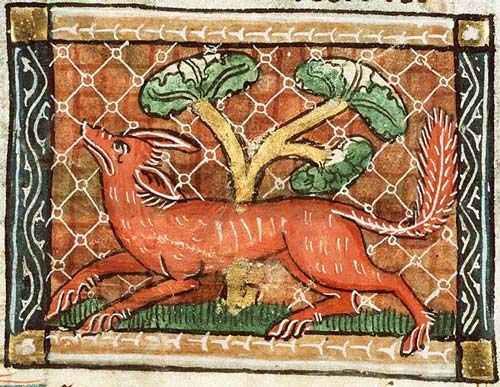
The Red Fox of our northern hemisphere is the smallest feral member of the Dog Family. To the human eye this mammal comports itself with a fascinating combination of dog-like and cat-like mannerisms in locomotion, stalking and play. The tail of this creature makes up a significant part of its weight, providing its limber body with a counterpoise than enables it to achieve feats of agility. The red fox can spring and hop as well as any feline. Their immature offspring (kits), come in delightfully (and protectively -- think camouflage) mottled color patterns, unique to each individual, combining black, russet, gray and white splotches (though I observed one kit that was entirely black). As predators they must compete in particular with their larger dog cousins, who will kill foxes, given the opportunity. Here in the East, they are threatened by the spreading encroachment of coyotes, who have crossed the Mississippi and are finally filling the gap left by extinct presence of the wolf in our part of the Country. The fox must have meadows and woodlands to thrive, and even in good conditions, they spread themselves thinly on the landscape. In Ohio where I live, a naturalist years ago once told me that there averages one fox family per seven square miles. I no longer know if this holds true with the pervasive encroachment of coyotes. The fox is a clever, shy and efficient creature, but they are vulnerable even without the madness of man impacting the landscape. In European folklore they are the "underdog" or "antihero" in the tales of Reynard or Reinhardt Fuchse, while in Asia (especially Japan) they are viewed as mystical, sometimes supernaturally dangerous creatures (like the way American Indians view the coyote), but whatever man chooses to ascribe to them, they are resourceful creatures who intelligently nurture their young and will take a moment to play like any good hound or house cat given the opportunity. They are vulnerable, their existence fragile, but they are wonderfully real, and when I am lucky enough to see one, I consider it a blessing and good omen to my life and mind.

Subscribe to:
Post Comments (Atom)









































No comments:
Post a Comment