Tuesday, May 31, 2011
"Small Government" is No Paradise for the Masses
It's the buzz word right now: "small government", or sometimes, "simple government". The conservative ideologues and demagogues talk about such a concept in two ways: "it's what the Founding Fathers really wanted", or they represent it as a "new" or "novel" idea. They paint what they believe to be an idyllic picture of the "liberty" to "fend for oneself" and the "liberty" not to be "interfered with". Such a form of government has in fact been the norm for most of human history. Small government in the Ancient, Medieval and Early Modern Worlds was all about being for and by a small and select group of aristocrats, plutocrats and war-makers and their narrow concerns, aims and interests. The rest of the population was left to the whim and mercy of the dominant members of their society. This arrangement came under various names through history, all amounting to the same thing: the feudal state, patrician republic, the despotic state, monarchy, oligarchy, the imperial state -- all of them spelled massive social injustice for the masses. Small government has never been about protecting the vulnerable. It has always been about facilitating the will of the powerful. History tells no other tale. The truth is quite the opposite of the currently-bruited revisionist-history myth of the libertarians: the small concept of government is exactly what our Founding Fathers were trying to liberate themselves from! Remember, the American colonists had no voice in the Imperial British Government, and the taxes they paid to that Imperial Government did not go toward improvements in their colonial living conditions. The Founding Fathers set up a democratic republic, empowered to make broad improvements for the country and to provide broad protections and privileges for the whole of its citizenry. It was the ultimate rejection of small government. It was government for everybody, and to effectively do this, it must be a large form of government. Otherwise, people with less financial clout will inevitably fall through the cracks. It all boils down to the perennial problem of human nature: it has its dark and selfish side. That is why (large) government was created in the first place: to effectively hold those dark and selfish tendencies in check.

Monday, May 30, 2011
Celebrate Neutral Space
In America, a most endangered piece of social geography is "neutral space". Such places were plentiful in earlier (even relatively recent) parts of our history, and were important in affirming our common social bonds as Americans of whatever ethnic or religious heritage. Now the so-called "culture wars", polarized partisanship, hate-baiting pundits, and ideologically slanted journalism have fomented the illusion that there are two species of human rather than one in this country. Public education, higher education, religion, comedy, national news, modes of transportation, forms of energy use, government services, infrastructure maintenance have all become sharply politicized, but the records show that these were once areas of common agreement. People of different religious sects or faiths once regularly formed friendships and shared social engagements. Comedy acts once appealed to people of all walks of life because the humor dealt with common fundamental experiences. Everyone agreed we needed to have a decent tax base to provide adequate public education for all children to maintain a fully functional and democratic society, and to keep bridges, public utilities and roads safely maintained. Providing public transportation for the masses was a must. The news had to be about reporting what was really happening and journalists had an ethical responsibility not to pull their punches. Higher education had to be about the seven liberal arts if we were to maintain the cultural health of the nation and be competitive and communicative with scientific endeavors and technological improvements around the world. Religion was a personal not a political matter. Yes, citizens who identified themselves either as Republicans or Democrats both agreed on these matters once upon a time. You don't believe me? Just read the newspaper archives! So what remains in terms of shared social space for people to just be people in our insanely divided society? Well, there are three neutral spaces significantly remaining that immediately come to mind: national and state parks, public libraries, and spectator sports. All three of these spaces are opportunities today for people of different political viewpoints, economic classes and cultural experiences to share social geography and re-discover our common humanity. In these places people can pass the time of day, share a laugh, talk about their lives, offer courtesies, and engage in mutual appreciation of what the setting has to offer. In these places is the seed of renewal for broad spectra of our society in terms of re-establishing our common bonds, aspirations and basic humanity as Americans. We are fortunate to have these remaining neutral spaces, but for them to enable us to restore our unity and therefore effectiveness as a society, we need to step away from our computer or television set and get out and use these spaces.
Sunday, May 29, 2011
My Rejection of "Positive Pessimism"
"Positive Pessimism" is my working phrase for an attitude justified in various philosophical, ideological or even mystical ways that people of genuine intellect and human feeling are increasingly adopting as problems such as climate change, economic downturns, declining middle class, and growing poverty worsen. I reject this stance, in whatever way it is rationalized, because it is one that will only make things easier for those who are creating these problems. I understand that people need to find a central idea they can attach themselves to in order to avoid the mentally paralyzing effects of despair and frustration. However, those of us given intellect and possessing genuine human feeling need to stand up for civilization -- not abandon it. So what do I mean by "positive pessimism"? Well, I use it to describe a collection of attitudes that are coalescing in various individuals who have lost their faith in the ideals of Western Civilization, but who want to preserve a positive attitude as they watch the pillars fall. Among religious or spiritually-driven people, it is (apparently unconsciously) re-instating a self-enslaving attitude once used by authoritarian religions both in the Occident and the Orient: this world cannot be improved but only endured. Ugh! This idea comes from a fatalistic attitude that we are put on this Earth by God, gods or angels only to be tested by negative forces, "to be purified by a refiner's fire". I do not argue against the point that life's challenges are an opportunity to discover new strengths and greater depths of compassion. It is quite true. But have we suddenly suffered amnesia for everything that has been accomplished in the name of humanity since the days of the Ancient Greeks and Hebrews? Right now, most of those in actual control of our now global society are not community-builders -- they value only profit not civilization. We must not mistake plutocracy for civilization. Don't throw the baby out with the bathwater! The bad things we are experiencing on this planet are not the fault of civilization but of greed -- which is not a civilized behavior at all. So now we have people preaching in both secular and sacred spheres that we need to withdraw from civilization, become backwoods anchorites with little gardens. That's nice for those who can afford the land and its taxes without also having to put on a tie and earn supporting funds in the capitalist world that still exists on the next main highway. Maybe I should be clear by what I mean by "civilization". I do not use the term loosely, nor do I mean it in the sneering way of Victorian colonialists. I mean it in the way people of the Ancient World, the Renaissance, the Enlightenment, and progressive 20th century society meant it: a way of living that makes community and individual life in this world better through a coherent system of shared and mutually supported ideals. This is achieved through public education, responsible science and technology, the arts, literature, honorably competitive sports, the social sciences, moral philosophy, inspiring architecture and aesthetics, the art and science of medicine. Let me be clear. These things do not create poverty in the developing world -- greed does this. These things do not create economic decline in developed countries -- greed does this. These things do not destroy and degrade the natural world -- greed does this. We must stand up for (and protect) the graces of civilization! If we abandon civilization as Pericles meant it, as Plato meant it, as Hillel meant it, as Seneca meant it, as Alfred the Great meant it, as Dante meant it, as Nachmanides meant it, as Erasmus meant it, as Kant meant it, as Franklin Roosevelt meant it, as Gandhi meant it, as John F. Kennedy meant it, as Kenneth Clark meant it, as Martin Luther King, Jr meant it -- we abandon the collective soul we have worked so hard to form since our species began the road of rejecting barbarism.
Thursday, May 26, 2011
Giving Thanks to the Little Ones Within Us
We may give thanks to God or gods, we may give thanks to friends or family. We may give thanks to a receptive audience or even a kindly stranger. But what of our bodies? People have likened our physical forms to a "biological machine." Such a metaphor does not support an entirely helpful attitude. Machines are often ill used or at least roughly used, and because we think of machines as inanimate and disposable, we often do not treat them with sensitive respect (though classic automobile restorers do show proper care for their machines). Our bodies unfortunately are disposable, but far less so if we only showed them the proper appreciation they deserve. A metaphor that better fits with what biologists and microbiologists now know about the human body would be to liken it to a biological community. We have been taught to think in terms of a functional hierarchy of fixed cells, tissues, organs and anatomical systems. But our physical forms also consist of untold numbers of mobile cellular entities of a highly varied nature, which (along with molecular hormones) communicate vital information between organs and tissues, protect them from microbial invaders of many kinds, see that certain nutrients are delivered to them, and strive to keep them from shutting down by shocking stresses. These busily moving life-forms created by our own body work endlessly to keep us in good form until they literally wear out from their selfless work. It occurs to me that our flesh and bones are like a coral reef, and there is a colony of myriad entities that give life to that reef. We should give thanks to these little intra-cellular forms, even if we may not know each of their long and complicated scientific names. These little beings are as critical to our survival as the nutrition we take in, and the water we drink. Think about it, even when we put our bodies through punishing stresses, or abuse alcohol or drugs, or eat unhealthy foods, these wee critters are still trying to hold us together, even under desperate circumstances with little to work with. They never ask us to try to treat our bodies with respect, rest, and healthful conditioning. They just keep working, endeavoring to maintain the life of our body, second after second, hour after hour, week in week out, month in month out, year after year, decade after decade, ceaselessly, until death is utterly unavoidable. So let us give thanks to these humble little beings that make it possible to walk and talk and think and work (and play) upon this precious Earth. Psychiatrists today say that good thoughts themselves form molecules of nourishment for the physical forms we inhabit. Food for thought -- or is it the other way around?
Friday, May 20, 2011
What is a Person Worth?
"Western Society" prides itself in being the most "civilized" culture in terms of the way we teach our citizenry to value themselves, but we traditionally and to this day have sent mixed signals in terms of moral/ethical standards. Of course in terms of how women are and have been dubiously taught to value themselves, much has been written and debated. What needs more discussion is how our culture generally inculcates self-worth in people, especially young men and especially working class/lower middle class males. In the Ancient World in the Mediterranean cradle of our current civilization, the Roman social elite called the common folk "proles", which translates in substance as, "those who contribute to the population". In the labor-hungry, human-powered and largely slave-driven world of Antiquity, the average person was most prized for their reproductive ability. As sad as this was, there has been an even more unfortunate way our society has been teaching people to value themselves, and it stems from religious perversions of Christ's teachings which prize "martyrdom" and "holy war" as worthy uses of one's life. These perversions have become increasingly secularized over the centuries, and manifest themselves in fascistic notions of patriotism. People have tried to justify such dogma as relating to the "super ego", but again, this is another perversion, this time of psychology. When a person selflessly sacrifices him or herself for the life of another, that is altruism if the person making the sacrifice has a sense of their own value as a living human being in his or her own right before making such sacrifice for another. But when a person has been taught directly or by implication through various modes of propaganda that their only real value is their ability to give their life for some cause, that is a form of pernicious social diminishment. Yes, young men and young women may not yet have lived long enough to understand their own self-worth, but that is the point. They deserve that time, and they deserve a decent system of higher/technical education and/or workplace mentorship to acquire that sense of self-worth. We also need responsible religious leaders who ethically distinguish the moral implications of Christ's soteriological sacrifice as a spiritual Savior from the kinds of moral sacrifice we mere mortals might make when it is absolutely necessary. We need to think of ways in which people can make a positive difference through the gifts of their living being. Defending one's country against invaders is a necessary evil of this world, and we are fortunate to have people who are dedicated to the safety of our nations against people who would do us harm. However, there are other ways one can express one's need to be patriotic that do not offer up one's life as collateral, such as (for America at least) the Peace Corps or Americorps. Promotion of military enlistment for young people at loose ends after high school is often pushed as something more constructive than for such individuals to try to get a job or acquire more education to improve their employment prospects. The military is a good option to consider (among many) if they can learn a decent skill in the armed services and are not merely bound for a psychological and physical meat-grinder that will scar them for life inside and out. There is a bit of a fait accompli going on here. There are very few good jobs out there for people of limited education or for whom college is not a good mental fit, and this was true years before the Great Recession began. If one asks why there isn't a draft, this could be one good practical reason why -- there is no need! With no decent jobs, what choice is there but to join the military? Recruitment has very little competition -- most of the union factories are gone. The surge to destroy collective bargaining rights, the legal barricades and blacklisting set up against whistle blowers for workplace abuses and bad working conditions also send a clear signal to young people that as citizen workers, they are not valued by society. However, the cable/satellite channels are buzzing with commercials and documentaries that ballyhoo the central (and superior) respectability of a military identity. We do indeed need military career people, both officers and non-commissioned soldiers, but a democratic society also needs a gainfully employed civilian population to maintain a healthy balance.
Saturday, May 14, 2011
So Called "Indian Time"
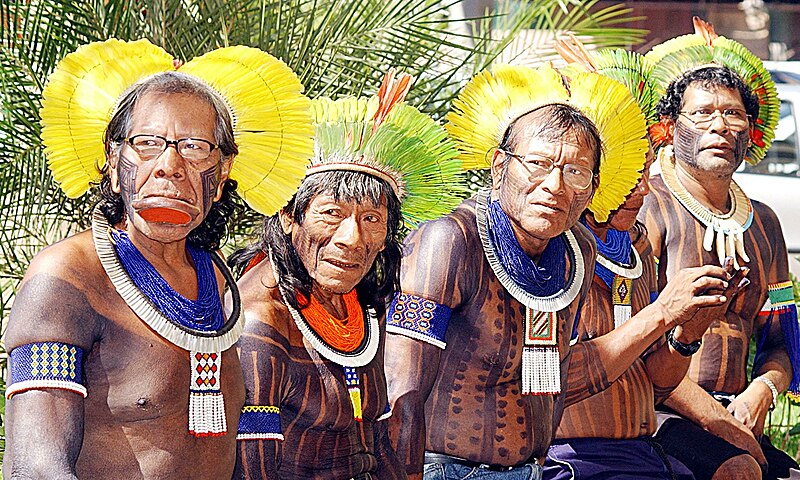
"On Indian Time", a common phrase, sometimes used pejoratively, occasionally with affection, more often used in neutrally descriptive contexts, describes a Eurocentric reaction to the tempo by which native peoples in North America executed their daily tasks. Even by the 16th century, the clockwork mentality of European culture was gelling, and this at the time when significant social relations were really beginning between Amerindians and European colonists. Actually, "Indian time" was a perspective on time shared by all human ethnic groups before entering an urban-oriented tenor of life, whereupon intense schedules of trade trickled down to affect even rural farmers. Of course, at its onset, this more structured, scheduled form of existence was not so rigid and ruthlessly efficient as it is today, but it was in comparative terms with tribal horticultural/hunter-gatherer cultures it ran up against. The population pressure and resource-hungry economy of European civilization was the real root of difference between the European sense of time and the way of life they encountered among the aboriginal inhabitants of the New World. Increased mechanization with the emergence of the industrial revolution in the nineteenth century only widened the gap in attitudes toward time and work between European Americans and Native Americans. Yet if we think of "Indian Time" as really an unstructured, freer sensibility of the use of time to pursue constructive tasks of thinking and doing, it is the most valuable use of time in which human beings can engage. It is in "Indian Time", that many important, often breakthrough innovations are achieved, and have been for tens of thousands of years of human cultural development. Yet even on the most practical terms, a more open sense of time was exactly what was needed when, for instance, hunting was a key component of survival; hunting not for sport but for real subsistence required patience, unstructured time, and the keener level of observation and perception only such an "un-scheduled" approach can beget. On the other hand, if "Scheduled Time" is the polar opposite, the utility of that acute form of time sensibility lies in the maintenance of the mega-complex of routine needs in an efficiently coordinated society on the competitive fast-track. Yet if the latter is the world of time in which most of us now exist, we must still (somehow) leave room for the former, older sensibility of time, otherwise there will eventually be no more significant progress in human thought and achievement. We must leave time to "play with our imagination", or we will stultify from an excess of efficiency. The utter domination of the scheduled existence inevitably leads to the cultural nadir we call "stagnation".
Subscribe to:
Comments (Atom)